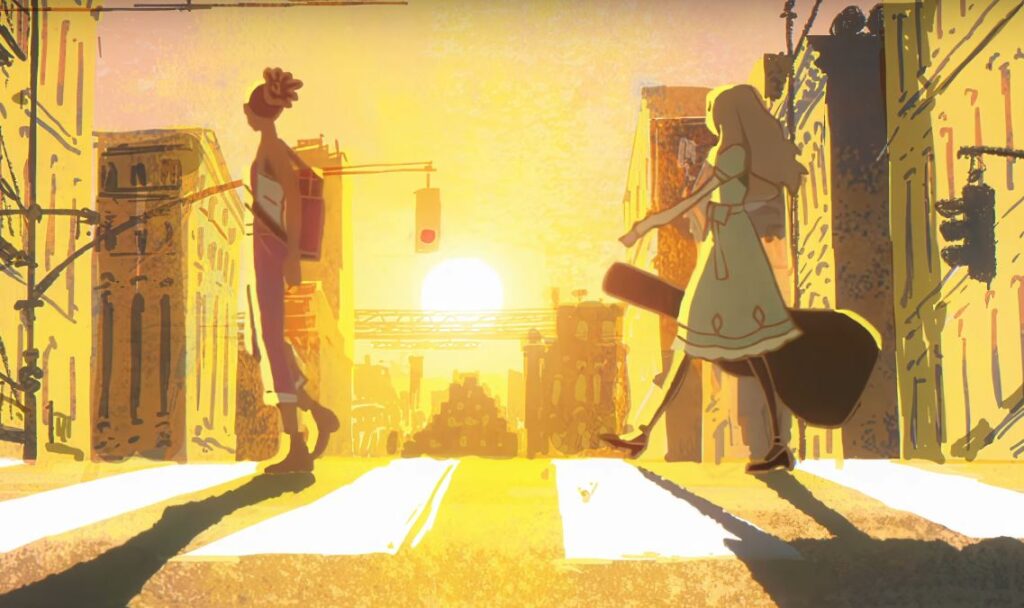
This one’s been on my list since it came out. Directed by Shinichiro Watanabe, set in the Cowboy Bebop universe and yet fully distinct and not a sequel or derivative work? In the anime world, fewer things can get me more excited. Ultimately it took me picking it on a whim to start while traveling for me to actually watch it, and I’m kicking myself for waiting this long.
First, I should acknowledge two things: one, that from what I have found out in admittedly, surface-level digging, while Watanabe was the director for Carole and Tuesday he was not involved in specifics to the same level as he was in his earlier works. This leads in to my second acknowledgement: it is not as good as Bebop, or Samurai Champloo—much like how Titan A.E. isn’t as good as The Secret of NIMH.
Not living up to the same level as a world-class production is no mark of shame; even with technical falterings I’ll address later, Carole and Tuesday is certainly not a black sheep of Watanabe’s directorial work. Like all his notable productions, music is as key to the final product as the visuals. Plot is important but secondary, serving largely as a vehicle to deliver pivotal moments. The first half of the show is about the rise of the titular characters: the naive, ethereal Tuesday and the down-to-earth, outgoing Carole. They’re given ample but not excessive screen time to make viewers want to see them break into the music industry with their heartfelt songs and sincere attitudes, and a few misadventures along the way spice up what would otherwise be a mundane journey. The fact that they’re a basic keyboard-and-guitar duo of singers in a near-future era dominated by flashy productions, AI-driven music (which was in retrospect an unexpectedly on-point prediction) adds an interesting subplot of how music from the heart can speak to people on a level that algorithm-derived megahits can’t match.
This largely falls off in favor of the second arc’s plotline, which is in essence thinly-veiled allegory for the US immigration situation. An even thinner-veiled expy of Donald Trump runs a campaign of division, fueled by a manipulative pollster who makes use of AI to callously pick the most winnable path to victory, morals be damned. I would’ve preferred the show to remain focused on the struggle between Carole and Tuesday’s unintentional musical revolution against AI music, although I don’t agree with reviews that say this political conflict was hamfisted. It felt like a natural, if quick transition from one plot to the other—and the conclusion was true to the spirit of the show, albeit right on the edge of heartfelt and hokey.
With that said, there were some missteps in my view. One of the biggest is tying it to the Bebop setting, or being set on Mars in general. We’re seriously expected to believe that Instagram is still using its current layout—hell, that it still exists as Instagram in the 2070s—after Earth was rendered barely habitable and humanity’s center moved to another planet? Or that the successor to Earth’s Grammy awards will just be called the ‘Mars Grammys?’
There’s also the animation. In the openings, particularly the second one, a messy, active style is used that isn’t unlike a very toned down version of the western animation world’s ‘Squigglevision.’ I found it to add a youthful charm to the visuals, matching the warm atmosphere of two young kids enjoying the moment and working towards their shared dream. There are shots in the episodes proper where the line between ‘expressive’ and ‘sloppy’ is crossed, as well as a few egregious uses of rotoscoping (a few mind you, not all of them.) Studio BONES’ usual work is cleaner, so I wonder if it’s a matter of them not being accustomed to an intentionally messy style.
There are strange narrative decisions too, such as explaining a character’s intersex nature by being caused by ‘hormone levels fluctuating on Mars’ yet being the only example of such a circumstance. Also missed opportunities, such as the relatively flat personal arcs of the main characters. Carole and Tuesday have shades of personal growth, mostly in Tuesday becoming more self-assured and able to confront her mother’s neglect. Yet from their first meeting to moving in together, to going from unknown street performers to Grammy-nominated musicians, they had no conflict. No moments of friction between them greater than concerned looks followed by sincere conversations ending happily. Look, it’d be great if we could all be so wise. I’m sure some seventeen year old girls are that wise. It’s just very difficult to believe a story that presents two of them as happening to meet and share the same interests.
Personally, I believe that the creator(s) of the two main characters loved them, but were perhaps averse to making them suffer. I understand that feeling; when I make a character I fall in love with, which is not often, the idea of putting them through hardship is unpleasant to say the least. It took me a long time to understand that it’s a better story if the happy ending is earned, not given—and it’s also more relatable to us in reality who are often lucky to have a happy ending at all. I would hate to see the show bogged down in melodrama, but a little drama is not such a bad thing.
Ultimately, Carole and Tuesday feels like a show made to honor music, and the shared joy we experience in listening to it. Music is one of, perhaps the last remaining piece of culture we might all experience at the same time. Perhaps that’s why the chosen genre for this Watanabe-directed work was pop music; songs designed to be popular, an expression of skill as much as art. In my subjective opinion, I thought the music was good. Surprisingly western even for Watanabe, but aside from a few vocal mismatches between voice actor and singing voice actor the music meshed excellently. While Watanabe’s top work in my eyes is still the masterful blend of stylized Edo-era life with the sound and soul of hip-hop that is Samurai Champloo, I’m a happier person for having watched Carole and Tuesday—who can’t wait to see his next project.
