(This post is an edited audio transcription. I’ve been watching a lot of movies compared to my usual lately!)
Conclave was an unexpectedly good movie. I was expecting a downplayed Dan Brown affair, not something of this caliber. I watched it recently for reasons obvious to anyone with access to the internet, or who lives within eyeshot of Vatican City. It felt like an appropriate time. Thankfully, the actual conclave this year was less eventful than the one in the movie. Though, the outcome of the movie’s conclave would’ve been magnificent in this day and age.
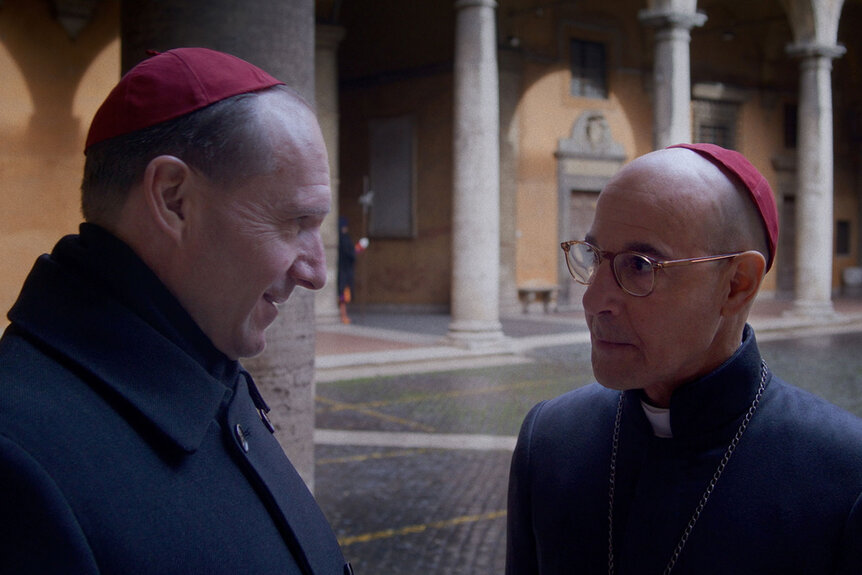
I was legitimately impressed by how well some of the more well-known actors blended into their roles. I didn’t recognize Ralph Fiennes for probably the first thirty minutes of the movie. And John Lithgow, I only noticed because I checked IMDB. What I found disconcerting upon post-watch retrospect however is the realization of how deep modern cinema’s training is on me, to make me expect a rather hamfisted, bombastic twist. You know, something like a Game of Thrones-style assassination. Perhaps that’s partly colored by the courtyard present in the movie as a gathering place for the cardinals. It looks very much like the kind of courtyard you’d see the Lannisters plotting some sort of scheme in, but there’s nothing of the sort with that. They are scheming, but it never goes into this overly dramatic representation of victory at all costs. It’s politicking, estimating votes and attempting to maneuver coalitions to one candidate or another.
There’s great care given to the symbolism and history of Catholicism too, sometimes just simple shots of parts of the Sistine Chapel or in subtler ways, how some of the cardinals carry themselves. I admittedly am not the most versed of Catholic scholars, especially as an ex-Catholic myself, but I thought the movie did a fine job at capturing the political realities of mortal men trying to maneuver into the seat of God’s voice on this earth. It’s that juxtaposition of perhaps true faith, but certainly ulterior motives run amok.
It’s the kind of maneuvering that Jesus Christ would probably have been quite upset about, as he would have been with most things that have happened in modern society, I think. But in terms of a thriller? Expertly done. It subverts modern expectations of thrillers, by not subverting its own pre-established trend. The most dramatic occurrence is both quite stark in contrast to this sequestered little election they’re having, but it’s also all too real. A suicide bomber attacks St. Peter’s Square, and collateral damage causes one of the windows of the Sistine Chapel to break during a vote.
It’s something that could certainly happen, and while I am grateful that it did not in real life (this time), it was an excellent way to both show tension and wrap around to the reality of violence in the world, and arguably the main moral reason to even have a Pope: so that worldly violence on a macro scale might be diminished. It did well to lead into Cardinal Benitez and his speech shortly later in the movie, reminding others that it’s so easy to talk of war. His experience was in Afghanistan and other nations, but I couldn’t help but think of how many people in the United States are so dismissive of the systematic, piecemeal culling happening in Gaza—or Ukraine’s nigh-implacable stalemate. Many of us fall into using those wars as a talking point, forgetting the human cost being paid every minute of our bickering.
It’s absolutely another thing to witness it for yourself, not just having ‘seen the videos.’ Plus as a speech nerd, I rather liked that speech. It’s not so much the words used, but the delivery. The moment it was delivered and to whom. Structurally it was a rather basic speech, but it was absolutely exactly the right thing to say to the right people at the right time. That’s the importance of speechcraft. Not creating the most compelling wordplay, not classical oratory. If you can do that, you’ll be one of the greatest orators of all time. It’s why Obama is lauded as one of the best orators in living memory. He’s not the most eloquent of speakers at that high level. Don’t get me wrong, he is certainly eloquent, but there are better. But his practiced charm, measured delivery and easy smile (yet practiced to a science, as evidenced by this fantastic video) combine for a career of lasting, impactful speeches. Nothing more, nothing less. But I digress.
Conclave’s twist at the end, which I won’t mention because even if you aren’t sure you’re going to watch the movie, is arguably more relevant than ever, thanks to our cultural backslide on issues of gender and who we are as people versus the neat little boxes people wish to put other people—and sometimes ourselves—in. The character is not explicitly what some others who might resonate with the character are like exactly, but the message of confused identity and ultimately, acceptance of who one is regardless of physicality comes through with touching sincerity in the final scenes of the movie. Many reforms of the Catholic Church have come about due to individuals who met the moment or seized an opportunity despite naysayers, threats or even outright violence.
Change is the nature of any organization that lasts as long as the Church has. It has to keep its spiritual center, but just as the Bible has shifted over the generations and parts have been removed or edited, so too has the Church changed in every way but its most core values. The Bible may be the Word of God, but we only can comprehend so much, and there’s only so much that we can actually say is definitively true and not our own flawed misinterpretations of it. So, we revise it. We attempt to better understand what God has sent down to us. That’s why we have a Pope. The whole reason we have a Pope is to allow the opportunity for change and adjustment with the Church. If we didn’t need that or want that, then why even have the papacy at all? Why not just have an unchanging Bible, and obey it to the letter? It’s all about interpretation. When God sent the commandments down to Moses, he was the only one who heard the truth of God’s word. Everyone else? They had to take Moses’ word for it, that the tablets were genuine.
I’m very glad I watched this movie, and I was even more delighted to find out that this movie is based off of a book by my absolute favorite historical fiction author and one of my favorite authors in general, Robert Harris. I read his Cicero Trilogy, as well as his Roman Empire-set book Pompeii years ago. If you want a courtroom drama set in ancient Rome that takes appropriate stylistic liberties only when necessary, but otherwise sticks true to the spirit of Cicero’s life as much as we know it under the backdrop of the last days of the Roman Republic, I can’t recommend that trilogy enough. It’s good writing, compelling and while not a 100% true-to-life retelling of Cicero’s life by any means, it’s an excellent primer to get someone interested in learning more about the reality of the man and his era. If you know someone who you think would find the Roman Republic era interesting, get them to read this book because if nothing else, it will spark their interest to find out that full story.
The point is, I’m happy to see anything Robert Harris writes get prominence. Conclave was a stellar movie, and now I can’t wait to read the book. A truly excellent movie though. Excellent movie.
