Historically, I’ve never been a manga guy at all. In fact, until this manga I’ve only ever read the Hellsing manga—and that was back in middle school. It’s not that I don’t like the genre; I just couldn’t afford it, and I never really got into reading PDFs on my computer (the notion of putting them on an e-reader or tablet did not occur to me for the longest time.)
So this is all to say that I am not the manga veteran presenting my learned perspective of the latest work I’ve consumed, but a near-total newcomer. With that said, this will likely remain one of, if not my favorite manga of all time. It’s inspired me to take a stab at the romance genre myself, and renewed my appreciation for a medium that I’ve let slip by me for years until now. To those not aware, Bloom Into You is a yuri (Girls’ Love? Shoujo-ai? I still don’t know what the most appropriate term is, so tradition wins out) story that’s as much romance as it is coming-of-age. The two heroines, Nanami Touko and Koito Yuu, each must discover who they are becoming as young soon-to-be adults, while also fumbling over what they each believe ‘love’ means. From one perspective, they enter a relationship remarkably early into the story; from another, it’s only in the final volume that they actually take the mutual step to become a couple.
The arduous emotional journey Touko endures to finally realize the errors of her relationship ways isn’t why I enjoyed this story the most, or Yuu’s unexpected growth from quiet and indecisive to a rather blunt and even assertive young woman. It’s the characters, and the art as well.
The Characters
Each of the characters in the manga, from the twin protagonists to side characters present for just a few chapters felt like real people. Touko’s hypocrisy was all too relatable, and seeing how the simple desire to honor her sister’s memory twisted her into a nerve-wracked pressure cooker of a girl who was destined for a life of false identities, or an eventual breakdown was a compelling glimpse of human imperfection. As someone who never made it out of the quiet ‘side guy’ in high school, Yuu’s emergence from that state was a moment of vicarious triumph.
Chief among characters for me? Saeki Sayaka, the tritagonist of the story. The closest friend of Touko at the outset, she takes the role of romantic rival, the thematic rival of Yuu. Over the course of the story however, she does not try to sabotage the two protagonists’ relationship. Nor does she ever come off as a sore loser. Sayaka remains Touko’s steadfast friend and confidant, even managing to forge an amicable acquaintanceship with Yuu. She is a quiet character of a more subtle type, one who has no problem being social, but is unable to allow her feelings to get in the way of what she believes to be the best course of action. She bottles her love for Touko up because she believes it’d just distract Touko, and put undue pressure on her.
We eventually figure out that Sayaka is also afraid of what Touko’s answer might be—a response no doubt influenced by the abrupt end to her previous relationship, made all the worse by her ex-girlfriend’s dismissal of Sayaka’s sexuality as an unfortunate result of a phase gone on too long. Far from a tragic character, Sakaya gets not just resolution to this previous rejection, but she’s gently mentored by a friendly manager at a local coffee shop through occasional chats which help encourage Sayaka to ultimately admit her feelings to Touko—and perhaps even more poignantly, accept Touko’s rejection of those romantic feelings while still preserving their friendship.
The fact that Sayaka’s mentor, Kodama Miyako, is in a lesbian relationship that is presented with no pretense, fetishization or melodramatic reveal further reinforces my fondness of their dynamic. It’s a common trend in the story—no relationship is treated as something fantastic, unexpected or anything but two people who are fond of one another, whether it be Yuu’s older sister and her boyfriend or Miyako and her girlfriend. It’s refreshingly routine, and this coupled with Sayaka’s personal growth is the single biggest reason why I’m so fond of this manga.
The Art
I won’t claim that the art is the best ever, even by my own subjective standards. Nor is it the most intricate, or expressive—but the reason why I find it so compelling is because it manages to be executed very well regardless, and remarkably consistent. Characters have very expressive faces, with a subtle trend towards sharpness that really makes those frequent wide-eyed gazes in panels stand out. The girls’ school uniforms have a high collar that often adds a certain coziness to head-and-neck panels, and there remains a constant undercurrent of simple and elegant beauty in every page. Even the imperfections are endearing in their own way, such as how one panel has the student council building’s wall be just a little too slanted.
I was also pleasantly surprised by how subtle the fanservice was, and even then, infrequent. It never felt forced, and was usually in the form of large, detailed shots of the characters’ slender hands, or their eyes twinkling in ambient light. There are precisely two scenes where they’re showing more skin than a typical school uniform, and only one of those scenes is what would be considered ‘typical fanservice’ (the other being a rare element when bared skin is significant to the plot.)
For me, the art served as a subtle, if unintentional reminder of how this story straddled the line of ‘realism, but a bit more interesting than reality’ so well. My forte is writing, not art so I’m afraid I can’t offer more.
Summary
This is one of the few true 10/10 stories for me in either anime or manga. It left me wanting to read more each time I set my e-reader down, yet when the end finally came I didn’t feel a hollowness that’s all too common with the end of a compelling story. Yuu and Touko had a satisfying end to their story—which wasn’t so much an end to it, but an end to our viewing of it. The final panel is a shot of them several years into adulthood, venturing out into a starry night. They’re two souls harnessing the fruits of a life sprawled out before them, not joined at the hip, but independent people with their own goals, hopes and desires. Each supports the other, enabling their best qualities to rise to the forefront. It’s what a relationship should be—and then just a little bit better. Nakatani Nio is a mangaka I’m keen to follow regardless of her future works; anyone who enjoys complex characters and an innate sincerity to the work should check out Bloom Into You.
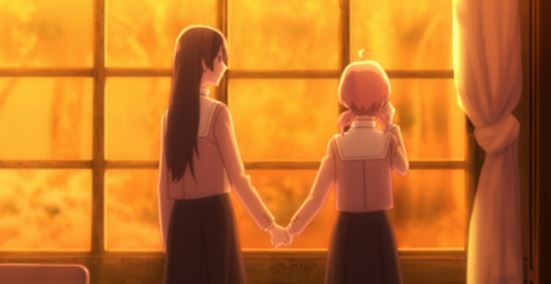
I should also add that, while it only adapts the first half of the manga (with a hasty adjustment at the end to provide some sense of a conclusion), the anime adaptation is worth watching for the coloring alone. Beautiful sunset shades of peach, orange and light reds are prominent, and seeing the characters in motion is well worth the short time investment.
