The first part of this review is spoiler-free, but after a point I marked (Ctrl+F ‘(NOTE: Spoilers beyond this point!)’ to find it) I do discuss story events, though I try to not literally spell them out.
My one-sentence summary: The Necromancer’s Tale is the greatest video game story I have ever experienced, and on par with better examples of classical fiction. It’s no Count of Monte Cristo, but it’s in the same ballpark.
Alright, that was two sentences but really, I can’t help but gush over this game. Necromancy based in real-world occultism, a deep narrative-driven experience that knows when to railroad and when to allow free exploration? The seamless blending of everything from rowdy tavern work to assaulting a city with a wave of undead? Did I mention necromancy represented with a depth I’ve not seen in games since the Mount&Blade module, Solid and Shade? Did I mention NECROMANCY?
I’ve had a deep fondness and interest with the discipline ever since I first entered the Blood Moor in Diablo II with nothing but a wand that let me raise a single skeleton. It was always the skeletal horde, the slow march of simple overwhelming numbers bolstered by the central occultist who was the keystone, the point of weakness—the ruler of a kingdom, vulnerable to a dagger like any other mortal. Yet to reach past the countless bones of their defenders? You’d need a much longer blade than that. I had my initial skepticism, but less than an hour in, The Necromancer’s Tale had made me a convert.
It’s turn-based, which seems to be popular though I am personally not a fan. I can tolerate turn-based combat if the thematic is good enough or the rest of the game is appealing, which is very much true in this case—but the combat system itself is rather simple. It’s not based on any pre-existing system other than the broad concept of tabletop combat, and has no saves or specialized stats to worry about other than strength, agility, constitution and mana. Your combat spells are extremely limited too—as after all, your army will do most of your fighting. Although, you can do a fair bit of damage with a handful of firearms kept in your inventory for sequential usage.
The graphics are a major plus for my tastes; they’re detailed where they need to be and simple elsewhere, playing to the strengths of an isometric perspective by making sure the big picture is generally appealing to look at. Zooming in reveals very basic character models, but their overall shape is well done, the clothing you can access is appropriate yet fetching, and the litany of character portraits shore up any weaknesses in the graphics themselves. They feel very much reminiscent of semi-early PC games such as Thief: The Dark Project or Arx Fatalis, with great texture application even if polygons are a valuable currency.
Ah, but the central focus, the reason I kept playing, and playing, and playing. The story. The writing! It’s not ‘good for a video game.’ It’s cohesive, it has natural flow, variance among characters—the peasants speak plainly, the nobles speak eloquently, the pompous Venetian speaks with agonizing and abundant prose while the brusque American dockworker speaks matter-of-fact. Set in early 18th century Europe, you’re in a fictional nation that I believe is located in a part of modern-day Slovenia, and the cultural representation of the characters—including the many foreigners—feels perfectly suited to the setting. Examples of at the time, contemporary literature such as Love in Excess (including a readable excerpt, a la the Elder Scrolls series’ fictional tomes) help to both heighten immersion and connect the more fantastical elements present to reality. The only games that I can recall which have comparable writing and immersive quality are Obsidian Entertainment’s Tyranny, Troika Games’ Vampire the Masquerade: Bloodlines and the first Mass Effect game, although that last one is very much a testament to the worldbuilding and not as much the main narrative.
But The Necromancer’s Tale? Every facet of its story is top notch. You don’t even begin with necromancy—in fact, it takes several hours before you reanimate your first minion. Yet the narrative is so compelling, even my bone-loving soul was happy to see where it took me before that pivotal moment. I wouldn’t make such an absolute claim like ‘it’s the best written video game story ever’ but it is tied, if not alone at the top of my personal list. That I can say without a shadow of a doubt. As I said earlier, I think it’s even approaching the quality of good novels, even classical literature (though limited by the restrictions of the medium, such as needing to allow for player decision making.)
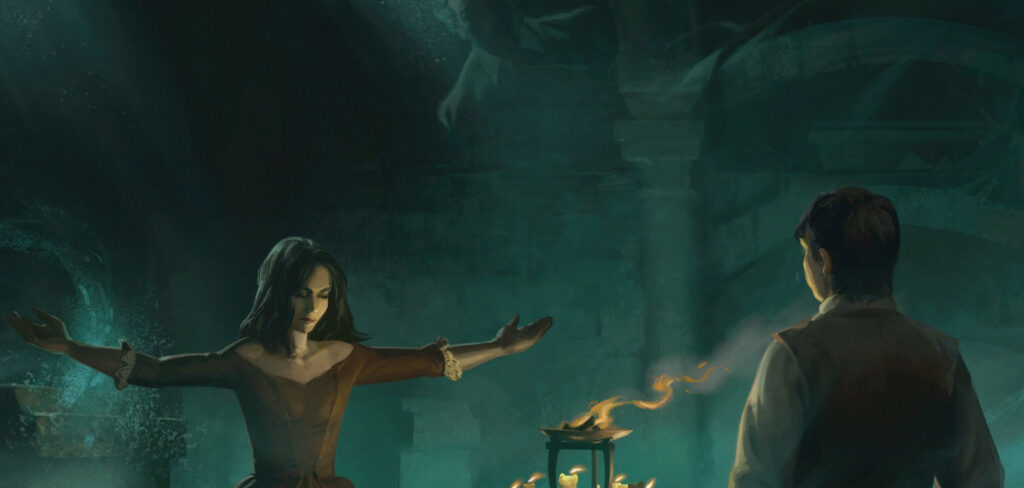
I mentioned Solid and Shade earlier, as the only other example I’m aware of in representing necromancy with true depth in games, not just spells that produce minions or thematically suitable attacks. As fond as I am of the Diablo II necromancer, at its core it’s really just a summoner playstyle. But here? You have your spellbook, an actual item you must carry around and decipher. You must gather reagents, prepare them accordingly, remember the correct order and content of the words of power—and ensure you’re not being observed. People tend to not like to see the dead being reanimated, or graves dug up en masse. It’s definitely made for fans of immersive real-world occultism; I’ve seen several complaints that necromancy is a bit boring and repetitive. These aren’t wrong: you will be spending a lot of time performing the same ritual on each of a pile of corpses you’ve gathered. The game does take some shortcuts to quicken the rituals as you become more accustomed to the performance, but it’s never going to be as easy as ‘wave hand; skeleton rises.’ Though, it does come close eventually and with suitable justification.
(NOTE: Spoilers beyond this point!)
Ah, but the story. Not only well-written but impactful, gripping but truly, truly immersive. They have friendships and romance as possible avenues to pursue in this game, appropriately interspersed with your efforts elsewhere and tastefully written. It was after a night where my character’s lover and she made love that I genuinely considered stopping the game.
Some context: Oftentimes, you’ll hear ‘you can always stop playing’ in the field of video game narrative philosophy. If a game asks you to commit a deed you disapprove of, you can refuse no matter the game. You stop, and while you don’t know what happens next, you chose to not proceed. An infamous example is the ‘white phosphorous incident’ in Spec Ops: The Line. The game presents you with a scenario where you only have the choice of using white phosphorous to bomb an encampment. There’s no way to say no and turn around in the game, but you still have to choose to use it. By continuing to play, you chose to go down that path.
I was sitting there on the morning after, having already anointed myself a true necromancer by having reanimated the dead several times. I was far down the path. I had so much further to go. But I considered, for a long moment just stopping the game—at least, for that playthrough. Next time I’d play a character more driven, who would commit wholeheartedly to necromancy no matter what other distractions arose.
Ultimately, I chose to keep playing—my character chose to have her cake and eat it too. It was the first time I ever actually considered taking that option. A game with such good writing that I’d actually consider what I saw enough, if only to see my character with the happiness that was so clearly there.
There was another point I considered stopping, albeit for reasons near the opposite. I needed several components for a ritual, with one of them being the skin of a cat. I discovered this as my real-life cat was sitting on my chest, so perhaps this was a decision unfairly weighted by outside matters. In game, you also have a housecat in your family manor. I sat there for a long while, considering my options. With how immersive this game had been already, I was afraid of how visceral the text may be. What sounds may play. I knew it wouldn’t be exaggerated—but it would likely not hold back either.
I tried to catch the family housecat, but it sensed something was off and kept running away. That did not help my mood. I eventually gave up, resolving to find another cat in town. My search led me to a sleeping cat under a tree, and my character stood there staring at it for a long moment, knife in hand. She had already disturbed the dead, manipulated friends and violated holy sanctity in her pursuits. What was one animal’s life?
In the end, I couldn’t do it. Another choice was made, one that would’ve led my character to call off further delving into the necromantic arts. It wasn’t a moral choice, a resolution to not harm innocents or the defenseless. She had slain a farm animal in her prior efforts. A cat is really no different. But it wasn’t a logical choice. An alternative source for a cat’s skin presented itself through searching—an emotionally distant resolution that still let my character nudge their way further into amorality. ‘I will only disturb the long dead to further my necromancy.’ ‘What measure is a wild animal? It’d die anyway.’ ‘The cat was already dead.’ ‘They were just bandits.’ ‘A few innocents pale in comparison to what I could do with this power.’
You’re certainly presented with opportunities along those ever-eroding lines. Local conflicts present opportunities to be a vulture among the battlefield, and with careful planning and usage of your minions, you can field an impressive force with relatively little personal risk. The town of Marns and its surrounding wilderness is made to be a playground, although one hardly lawless. You can absolutely reanimate the corpse of a child dead by plague in front of their still-living friends, in broad daylight! Of course, you will be seen, arrested and hanged before the next sunset. Now, if you were to wait until nightfall and move the body somewhere private…In many ways, while the broad stroke of actions you take will be constant, the morality—or lack thereof—is entirely up to you. The game’s story knows when to narrow paths and when to remain open-ended, although as with most RPGs, the beginning holds the most variance. Still, right until the final shot of the game you will have the ability to make decisions with impact; the game never forgets that it’s above all else a vehicle for storytelling.
I’ve only seen one ending thus far, but I know at least three distinct ones exist. The one I received? It was the product of attempting to not dive freely into the depths of depravity. To pursue necromancy as a means to an end and a scholarly study, with my character’s beloved as their sole point of grounding. Their conscience, in essence—not so much the one that must bring them back from the brink, but the one that makes my character choose to step back from the brink. As long as she kept her affections, her trust, then she had the willpower to not become what the world would certainly see her as.
Even when my character became so detached from humanity that they felt no warmth from good deeds, only assurance that they would maintain their veil of civility, they still chose to keep that single thread of emotion alive. Although, it was hardly absolute. Had certain moments gone differently, there would have been nothing stopping her from embracing the vilest depths of death denied.
The ending itself? The final minutes of the story? It’s more of a playable epilogue in truth, but it was a shock. The culmination of my character choosing not humanity or undeath, but a balance. Not perfect, but close enough. They kept the power to stop, to decide ‘this is enough.’ In doing so, they opened the door for something that left me speechless. Suffice it to say, after a long rest they awoke to a world scarcely dreamed of, one they had an integral hand in laying the foundations of. It was a happy ending, and in my opinion the only kind of happy ending one could find in a story like this. Contentment and relief over ecstatic joy. Kubla khan, man.
In summary: I cannot recommend this game enough. It has been updated since launch with numerous fixes, dialogue tweaks and quality of life additions, so judge it by recent observations. If you love gothic tragedy, if you love settings where it’s historical-but-more, if you love necromancy, if you love good storytelling, if you love anything at all about what I have written here, then do yourself a favor and check The Necromancer’s Tale out. If I win the lottery I will buy all my friends a copy, and I will buy a random Steam user a copy each week for the rest of my life. This game is flippin’ incredible. Holy fuck.
